
What is HACCP?
A batch of ready-to-eat curry puffs comes back from the lab with no Salmonella detected, so the release form gets signed. A quality lead new to HACCP may read that result as proof the batch is safe. It is proof only about the units that were tested.
Take the numbers from a published sampling example: a lot of 100,000 chocolate bars with 1% contamination (1,000 bars), of which 60 are tested. The chance of catching the problem is about 45%, so the lot passes in 55% of cases. Contamination can also be unevenly spread within a batch and even within one pack. A negative result cannot show a whole lot is pathogen-free, and it arrives after the product is already made.
HACCP stands for Hazard Analysis and Critical Control Points. Codex Alimentarius describes it as a systematic, science-based approach to food safety that addresses biological, chemical and physical hazards across the food chain. In plain words, you list what could make the product unsafe (the hazard analysis), find the steps where you can stop or remove each hazard (the critical control points), and control those steps while production is running. For the curry puffs, that means the fry or bake step and the packing step, not the lab report at the end.
Testing still has a job. It confirms that the controls work, and HACCP is the system that prevents problems in the first place. The later sections show where each fits.
The four hazard types to control
Codex defines a hazard as a biological, chemical or physical agent in food, or a condition of food, that can cause an adverse health effect. Allergens are listed here as a fourth type for practical reasons. EU guidance places them among naturally occurring chemical hazards, but cross-contact and labelling make them need their own line in a hazard analysis. For the curry puffs, each type looks like this.
- Biological: Salmonella and Listeria monocytogenes from raw fillings, handlers or the packing environment. Labs confirm control with finished-product microbiology and environmental swabbing of contact surfaces.
- Chemical: pesticide residues or mycotoxins in flour and spices, and cleaning chemical residues on equipment. Labs confirm control with residue and mycotoxin analysis of incoming materials and rinse-water or surface checks after sanitising.
- Physical: metal, glass or hard plastic from machinery, lighting or packaging. Metal detectors catch most of it on the line, and the lab's role is limited to examining foreign matter after a complaint.
- Allergens: milk, egg, soy, peanut or gluten moving between products on a shared line, or missing from the label. Labs confirm control with allergen swabs after changeover cleaning and testing of finished product against the declared label.
Allergen failures show up in regulator data. The European Commission's 2022 report recorded 210 allergen-related RASFF notifications, with milk the most notified allergen (46) and cereals and bakery products the most reported category (32).
The hazard type decides the control measure, and the control measure decides which test verifies it.
The seven principles in plain language
Codex sets out seven principles, applied through a 12-step sequence that can be adapted to the operation. Before principle one come the preparatory steps: forming a HACCP team, describing the product and its intended use, and building a flow diagram of every process step. These sit on top of prerequisite programmes (GMP and GHP), which Codex says should be in place first. The curry puff example carries through each principle.
- Conduct a hazard analysis. List the hazards at each step and judge which need control. Raw chicken filling brings Salmonella.
- Determine critical control points (CCPs). A CCP is a step where control is essential to prevent or eliminate a hazard. For the puffs, baking or frying the filled pastry is the kill step.
- Establish critical limits. A critical limit is a criterion which separates acceptability from unacceptability, written as a number, such as a core temperature held for a set time.
- Establish monitoring procedures. Monitoring is a planned series of observations or measurements showing whether a CCP is under control. An operator probes the core temperature of several puffs each batch and logs it.
- Establish corrective actions. These are the actions taken when monitoring shows a loss of control. A batch that misses the limit is held, re-cooked or discarded, and the cause is fixed.
- Establish verification procedures. Verification checks that the whole plan works. Thermometer calibration, record review and finished-product tests belong here.
- Establish documentation and record-keeping. Write down the plan, its reasoning and every monitoring result, so someone else can see what happened to each batch.
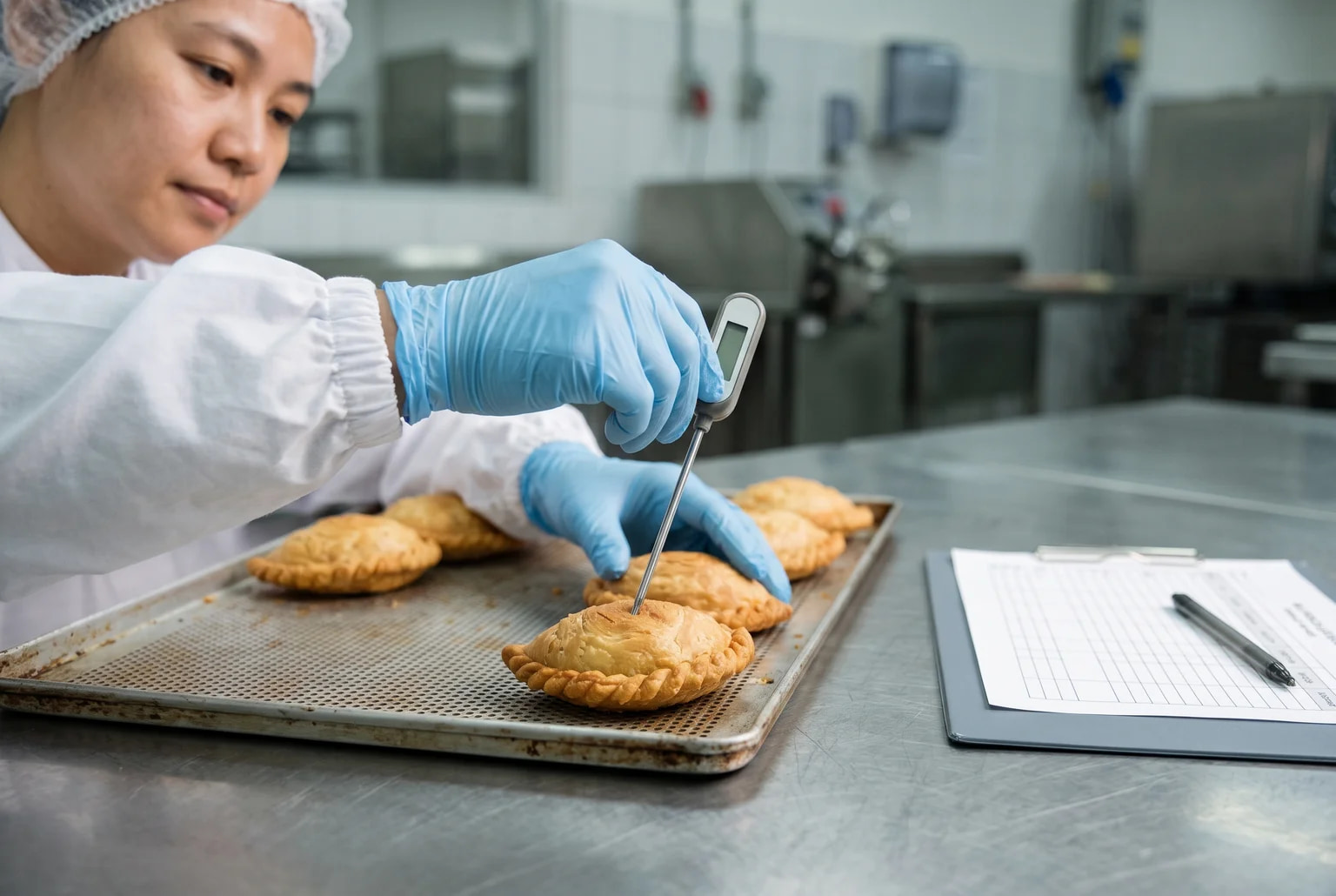 Measuring the core of a baked product and logging the result puts limits, monitoring and records into a single moment.
The principles form a logic chain, and each depends on the one before it. A limit means nothing at a step never identified as critical, and monitoring has nothing to measure without a limit. Corrective action has nothing to trigger it without monitoring. The implementation and audit pathway is covered in HACCP Certification in Malaysia: Steps, Costs and What Auditors Check.
A worked hazard analysis for a ready-to-eat product
This is an illustrative teaching example for a chilled curry puff with a cooked chicken filling, not a template for any real product. A real study needs the team's own flow diagram, data and validation.
Step | Hazard | Severity and likelihood | Control | CCP? |
|---|---|---|---|---|
Receive raw chicken | Biological: Salmonella | Severe; likely on raw poultry | Supplier approval, incoming checks | No, a later kill step controls it |
Shared-line changeover | Allergen: milk or egg cross-contact | Severe; possible after a rushed changeover | Cleaning procedure, allergen swab, label check | Often prerequisite-controlled |
Bake or fry | Biological: surviving Salmonella | Severe; certain without a kill step | Validated time and core temperature | Yes |
Sanitiser use | Chemical: residue | Moderate; unlikely with rinsing | Rinse and chemical handling controls | No |
Packing | Physical: metal fragments | Severe; low likelihood | Metal detector with test pieces | Often yes, if no later step removes it |
Codex's decision tree asks, for each significant hazard, whether prerequisite programmes already control it, whether a later step will, and whether this step can. Raw chicken is not a CCP because baking comes later. Supplier checks still apply, but the bake is the CCP because it is the essential kill step.
For the critical limit, FSIS lists chicken at 62.8°C held for 9.8 minutes for a 7-log Salmonella reduction at 7% fat. That is a US table value, not a cooking instruction. You must validate your limit for your product, oven, and humidity.
Write down each decision with its reasoning. Auditors and regulators ask why a step was or was not a CCP, and the record is your answer.
Where laboratory testing fits
Validation and verification are separate questions. Validation asks whether a control measure can work. Codex defines it as collecting scientific, technical, and observational evidence from literature, experiments such as challenge tests, or operating data. Verification asks whether the system keeps working as planned.
For the curry puff, validation means showing that the chosen bake time and core temperature reduce Salmonella to the intended level in your oven, with your filling. Lab challenge studies or process data supply that evidence.
Verification is routine. FSIS rules list calibration of monitoring instruments, observation of monitoring, and record review. For us, that covers probe thermometer calibration, finished-product microbiological tests and surface swabs after sanitizing. After a line changeover, an allergen-specific swab matters, because ATP swabs alone shouldn't verify allergen cleaning.
Accreditation changes how far a result carries. SAMM assesses labs against MS ISO/IEC 17025, but accreditation covers a defined scope. Before relying on a report, confirm the sample type, test, and method fall within the lab's current scope. KAS is SAMM-accredited and runs environmental swabbing.
Write the method and sampling plan into the HACCP plan: which swab sites, how many samples, which allergen, which method. Otherwise, results cannot compare results over time or defend them to an auditor.
Testing is evidence that the controls work. It does not replace the bake step or the changeover cleaning it checks.
The Malaysian rules that apply
The Food Act 1983 (Act 281) is the principal food safety statute. It is an enabling law: section 34 lets the Minister make regulations, and those regulations contain the technical detail. The Act itself sets out no HACCP plan requirement.
The Food Hygiene Regulations 2009 carry the hygiene duties. Regulation 9(1) requires a food safety assurance program at premises listed in the Third Schedule, which covers food manufacturing premises. The regulation does not name HACCP. Whether your plan satisfies it depends on how you design the program, so confirm by reading the regulation text or consulting a qualified advisor.
The Ministry of Health Malaysia (MOH) runs the Food Safety and Quality Program, which includes a HACCP certification scheme. MeSTI is a separate MOH scheme and should not be confused with it.
MS 1480 is the Malaysian Standard for food safety under the HACCP system. Malaysian Standards are generally voluntary unless a regulator makes them mandatory, so check whether any regulator or customer requires it for you.
The Food Regulations 1985 are the related rule set for labels, additives, and product composition, covered in the Food Act and regulations post.
Check which of these apply to your product category and premises before you build the plan.
How GMP, ISO 22000 and HACCP differ
The three work as layers. Codex treats good manufacturing practices as one kind of prerequisite program and describes properly applied prerequisite programs as the foundation for an effective HACCP system. ISO 22000 integrates the Codex HACCP principles with prerequisite programs and management-system requirements.
GMP | HACCP | ISO 22000 | |
|---|---|---|---|
What it is | Baseline hygiene and operating practices | Preventive method for specific hazards | Food safety management system standard |
Scope | Premises, people, equipment, processes | Hazards at defined process steps | Whole organization, including HACCP |
Certifiable | Not by itself as a standard | MS 1480 is the Malaysian HACCP standard | Yes, by external certification |
GMP wording also appears in cosmetics, where MoCRA GMP is a separate regime. The ISO 22000 in Malaysia post covers the standard in depth.
Build GMP first, HACCP on top, and ISO 22000 around both.
Practical next steps
Confirm the product and process flow, review prerequisite programs, list hazards by type, then mark which control points need lab evidence, with the tests and sampling plans each requires. KAS Lab offers a free consultation on environmental swabbing, allergen and microbiological testing.
Related reading:
- HACCP Certification in Malaysia: Steps, Costs and What Auditors Check
- Food Act 1983 and the regulations that sit under it
- MoCRA GMP implementation in Malaysia
Sources
- Relevance of microbial finished product testing in food safety management — Elsevier
- Food safety and quality assurance material — FAO
- RECOMMENDED INTERNATIONAL CODE OF PRACTICE GENERAL PRINCIPLES OF FOOD HYGIENE — FAO/WHO
- EU guidance on food hygiene — European Union
- 2022 Annual Report Alert and Cooperation Network — European Commission
- RECOMMENDED INTERNATIONAL CODE OF PRACTICE ... — FAO
- General Principles of Food Hygiene (CXC 1-1969) — FAO/WHO Codex Alimentarius
- FSIS Cooking Guideline for Meat and Poultry Products (Revised Appendix A) — FSIS
- Guidelines for the Validation of Food Safety Control Measures (CAC/GL 69-2008) — Codex Alimentarius
- 9 CFR Part 417 -- Hazard Analysis and Critical Control Point ... - eCFR — FSIS
- appendix 10: cleaning and sanitation for the control of allergens | fda — FDA
- Food Act 1983 (Act 281), Online 2026 — Attorney General’s Chambers of Malaysia
- Food Hygiene Regulations 2009 — FAOLEX
- Food Safety and Quality Program — Ministry of Health Malaysia
- Food Act 1983 Malaysia: Regulations and Hygiene Rules — Com
- ISO 22000:2018 — Food safety management systems — International Organization for Standardization
- Surface Swabbing for Microbial Analysis: A Comprehensive Step-by-Step — Com