
A swab from a packing line comes back positive. The lab report goes to the QA officer, who files it as a quality record. A copy reaches the food safety team leader, who logs it against the prerequisite program. The HACCP coordinator enters the same number in a monitoring or verification log. Three owners, three formats, and sometimes three conclusions: one calls it a nonconformity, one calls it an environmental trend, and one decides it is outside the HACCP plan altogether.
Take a hypothetical example. A mid-sized Malaysian food manufacturer gets a positive Listeria or Enterobacteriaceae result from a swab taken on a packing line. This is an illustration, not a client case. It runs through the rest of this post.
The three systems ask for related things. Codex HACCP principles include monitoring, corrective action, verification, and documentation. ISO 22000 builds those principles into a management system alongside prerequisite programs. ISO 9001 wants controlled records and action on nonconforming output. A single controlled laboratory record can satisfy all three.
This post shows how lab data can serve ISO 9001, ISO 22000, and HACCP in one integrated system, and what that looks like in practice. For background on the food safety standard, see this guide to ISO 22000 in Malaysia.
What Is an Integrated Management System, and How Does It Differ from a QMS?
A quality management system (QMS) is the set of policies, processes, and records that keeps product or service quality consistent. An integrated management system (IMS) coordinates two or more management system standards through one policy, one set of processes, shared documents and joint audits. The usual combination is ISO 9001 with ISO 14001 (environment) and ISO 45001 (occupational health and safety). Food, feed, pharma and cosmetic manufacturers with lab-driven controls add food safety. This post covers ISO 9001, ISO 22000 and HACCP because those manufacturers meet that combination most often.
Aspect | Standalone QMS | IMS |
|---|---|---|
Scope | Product or service quality | Quality plus food safety, and optionally environment, health and safety |
Policy | One quality policy | One policy covering every discipline in scope |
Documentation | Quality manual, procedures, records | One document hierarchy, with discipline-specific controls inside it |
Audits | Quality audit | Internal audits covering several standards in one visit |
Management review | Quality performance | Combined review of all disciplines |
Data ownership | QA owns the records | Shared records, with named owners per discipline |
Integration can reduce duplicated processes and records and bring audits and management reviews into line. ISO's common structure makes standards easier to combine, but discipline-specific requirements stay. A hazard analysis is still a hazard analysis.
Typical shared processes are document control, competence, supplier control, corrective action and internal audit. Lab data can then support both product conformity and food safety verification, provided methods, responsibilities, acceptance criteria and records are controlled. A good test record is a lab record that stands up to audit for every system that reads it.
Annex SL: The Common Structure Behind the Standards
Annex SL is the template ISO uses to write management system standards. Published within the ISO/IEC Directives, it sets a common ten-clause structure with shared core text and terms. ISO 9001:2015 and ISO 22000:2018 both follow it, so clauses 4 to 10 mean the same kind of thing in each. That is why one document control procedure or one internal audit program works for both.
Clause | Title | Where lab evidence sits |
|---|---|---|
1 to 3 | Scope, normative references, terms | None |
4 | Context of the organization | Indirect |
5 | Leadership | Indirect |
6 | Planning | Indirect |
7 | Support | Calibrated equipment, competent analysts, controlled methods, retained test records |
8 | Operation | Hazard control and product release checks |
9 | Performance evaluation | Monitoring results, trend analysis, internal audit and management review inputs |
10 | Improvement | Investigation and corrective action after an adverse result |
Clauses 7, 9 and 10 carry most of the lab evidence. Clause 8 differs by standard, and this is where ISO 22000 adds its food safety content: PRPs, traceability, validation of control measures in 8.5.3 and the HACCP/OPRP hazard control plan in 8.5.4. Monitoring and measurement of those controls sits in 8.7.
HACCP is not an Annex SL standard. It is a Codex method, and ISO 22000 builds its principles into clause 8. A plant certified to ISO 22000 therefore already runs HACCP inside a structure that lines up clause for clause with ISO 9001.
How ISO 9001, ISO 22000 and HACCP Fit Together
The three sit in layers, with GMP underneath.
Layer | What it manages | Lab evidence it uses |
|---|---|---|
ISO 9001 | Customer requirements, process control, nonconforming output | Specifications, release testing, complaint-versus-test comparisons |
ISO 22000 | Hazard analysis, PRPs, OPRPs, communication | Environmental monitoring, verification results |
HACCP | Critical control points with measurable limits | Validation and verification testing |
GMP and hygiene rules | Baseline conditions in the plant | Hygiene swabs, water and air checks |
In Malaysia, the GMP layer rests on the Food Act 1983, the Food Regulations 1985 and the Food Hygiene Regulations 2009, which the Ministry of Health lists as the basis of the HACCP framework. Codex HACCP uses seven principles applied through a 12-step sequence. ISO 22000 sorts controls into PRPs, OPRPs, and CCPs according to the hazard analysis. An OPRP uses action criteria and observation, while a CCP uses a measurable critical limit.
The overlap is in process control, records, and corrective action. The difference is what they focus on. ISO 9001 asks whether the product meets requirements and satisfies the customer. ISO 22000 and HACCP ask whether a hazard could reach the consumer.
Take the hypothetical packing line with a positive Enterobacteriaceae swab. The food safety team reopens the hazard analysis, reviews the control measures, and escalates monitoring. The quality team records a nonconformity under ISO 9001. One corrective action, closed with a verification retest, answers both.
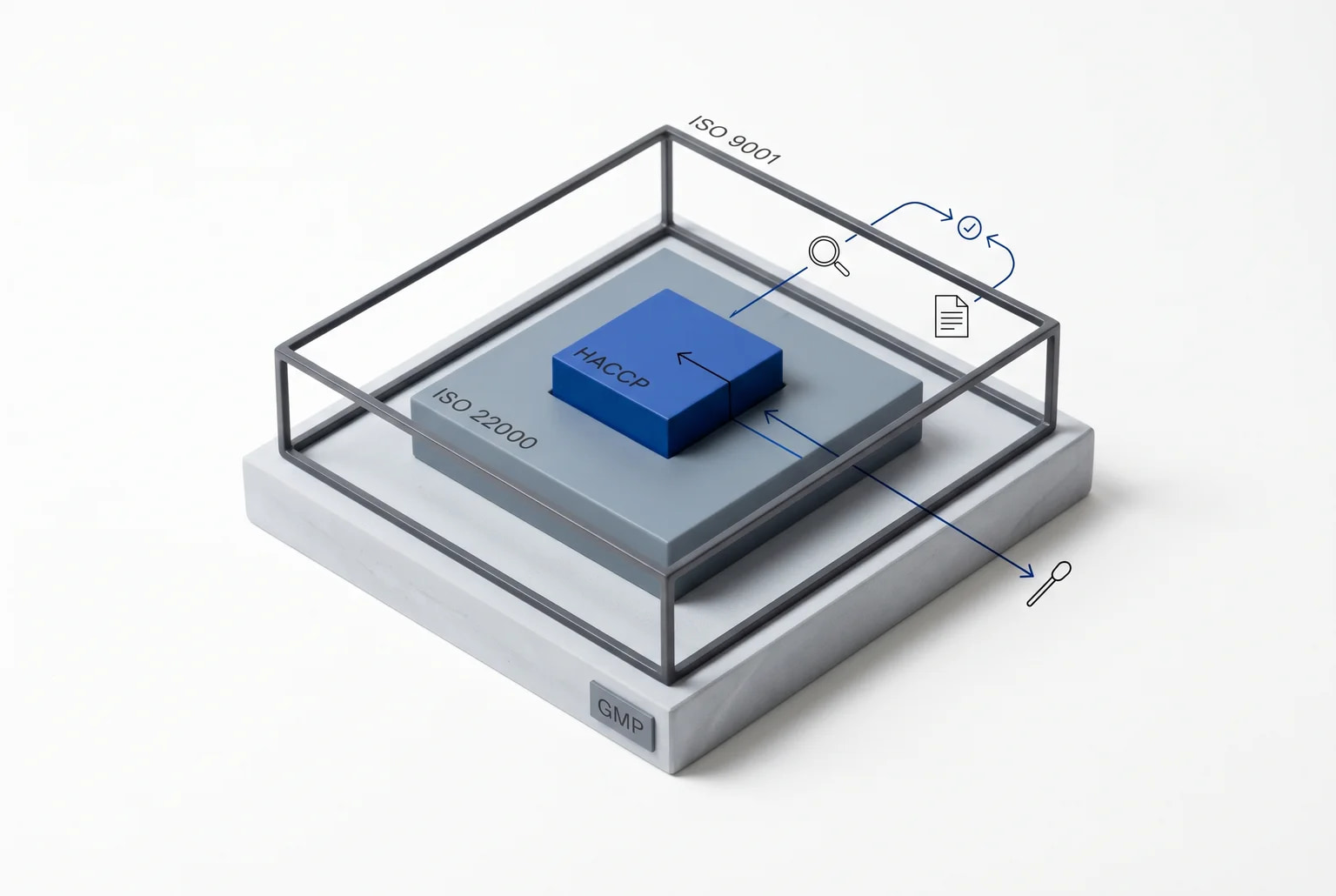 One positive swab travels through every layer, and a single corrective action answers both the food safety and quality systems.
How Laboratory Testing Data Becomes Shared Evidence
Each type of lab result answers a question in all three systems at once.
Lab data | Hazard control (22000/HACCP) | Quality (9001) |
|---|---|---|
Environmental swabs, finished-product microbiology | Verification under clause 8.8 | Product conformity against specification |
Chemical results (contaminants, allergens, residues) | Evidence that controls work | Release and customer requirements |
Shelf-life studies | Validation input | Expiry claims and product design |
Calibration records | Clause 8.7 monitoring resources | Clause 7.1.5 valid, reliable results |
Validation asks whether a control measure should work. Verification asks whether the implemented system continues to work. Validation evidence can include laboratory testing, and verification results should be analyzed for trends rather than filed one by one.
What accreditation means. ISO/IEC 17025 is the standard used to show a laboratory is competent, impartial, and consistently capable of technically valid results. Auditors ask how a result was generated because the number alone says nothing about the method behind it. The ISO 17025 explainer covers the standard in full.
What to check when outsourcing. Accreditation applies only to a defined scope: a named method, analyte, matrix, and range. The Department of Standards Malaysia (JSM) says labs should be judged on the specific test required. Confirm the method is in scope, the signatory is approved, and the report preserves sample identity and chain of custody.
Tracing one swab. On the hypothetical packing line, the Enterobacteriaceae result arrives with its method, zone, and sample ID. The quality record logs it against the hygiene specification. The food safety team treats it as a failed verification of the cleaning PRP. The corrective action cites the same report, and a retest closes it.
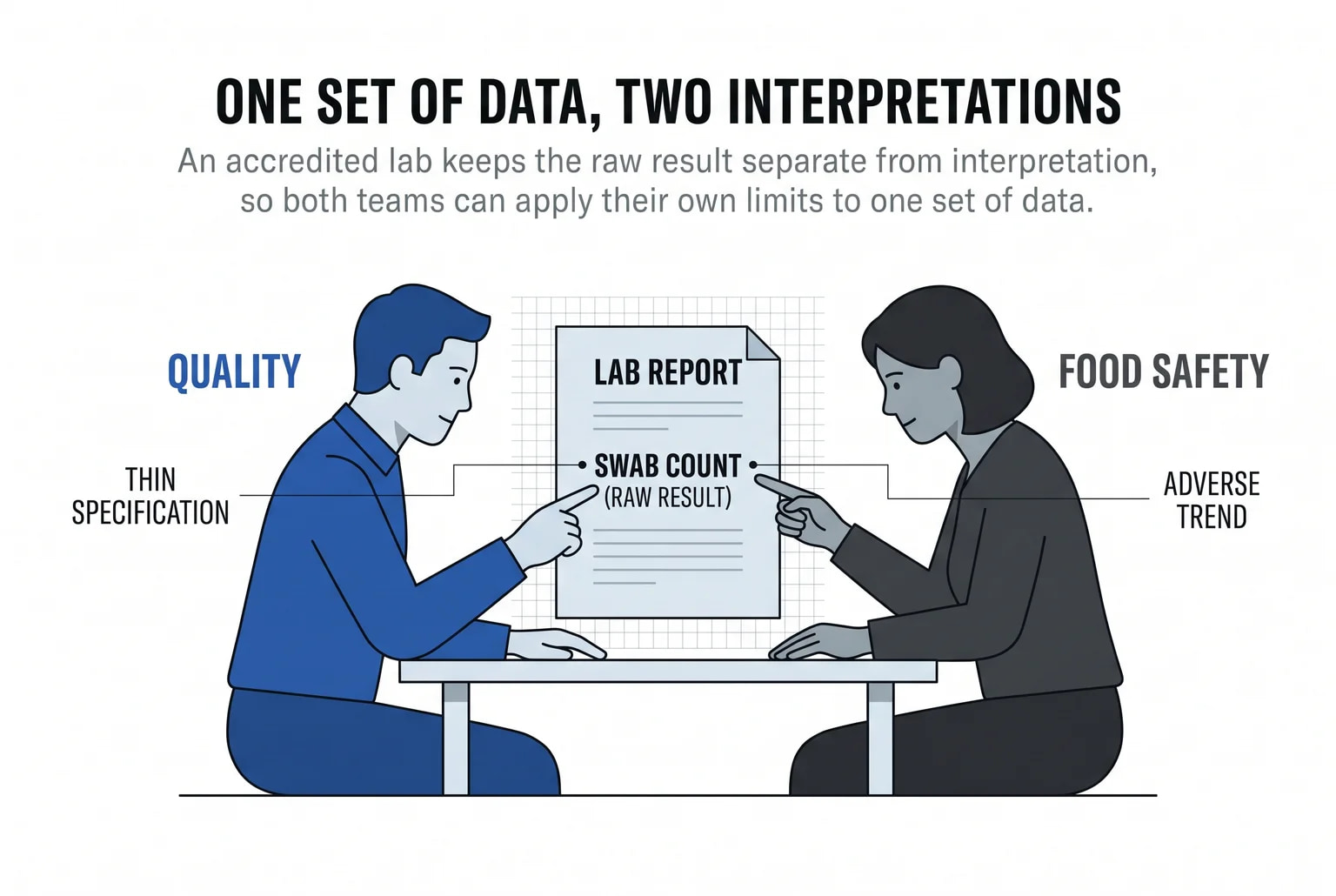
When teams read the number differently. Quality may call a count within specification while food safety calls it an adverse trend. An accredited lab keeps the raw result separate from interpretation, so both teams can apply their own limits to one set of data.
Four Procedures to Run Once Instead of Three Times
Four procedures gain the most from integration, and each runs once with the lab data plugged in.
Document control. One documented-information process can control creation, approval, revision, distribution, and withdrawal for the whole system. Test methods, sampling plans and microbiological limits sit in it as controlled documents, so quality and food safety read the same specification. Changes to formulation, packaging, process or suppliers should also trigger shelf-life re-validation.
Internal audit. ISO 22000 clause 9.2 requires planned audits of conformity and effective implementation. ISO 19011:2018 supports combined audits of several systems at once, so one process-organized, risk-based program can cover all three. Swab and finished-product trends tell the auditor which areas to sample first.
Management review. One meeting can combine quality, food safety and HACCP inputs while recording separate decisions where needed. Put swab trends on the agenda next to product test results, complaints and deviations, so the room can compare complaint volume with what the lab found.
Corrective action. One workflow covers containment, consequence assessment, root cause, action, effectiveness verification, and retained evidence. ISO 22000 requires corrective actions to be effective.
On the hypothetical packing line, the positive swab is closed once. Sanitation and product-impact assessment are recorded, then verification swabs are taken in the same area and, if needed, surrounding zones. The clean retest report closes the nonconformity, the PRP verification, and the HACCP record together.
A Step-by-Step Roadmap to Build the System
The usual implementation sequence runs from gap analysis through certification. For a lab-driven manufacturer, this order works.
- Gap analysis against ISO 9001, ISO 22000, and HACCP. One gap list, with duplicated requirements marked once.
- Scope and a single integrated policy. One scope statement and one policy naming product safety and customer requirements together.
- Map processes and records, including lab data flows. A map showing where each swab, product test, and calibration certificate is recorded and who reads it. On the hypothetical packing line, this is where the three separate logs for one swab appear.
- Consolidate documentation. Shared procedures on top, with plans, work instructions and records beneath.
- Shared monitoring and a lab data plan. A table of what is tested, how often, by whom, and with which accredited method. Settle sampling, result authorization, and abnormal-result actions before documents are approved. The scenario's swab limits, zones and retest rule belong here. For outsourced tests, check that the lab's ISO 17025 scope covers the method.
- Train staff and run internal audits. Findings written against shared processes and specialist controls.
- Hold a management review. Record decisions on findings, complaints, nonconformities, objectives and resources.
- Certification audit. A Stage 1 readiness review, then a Stage 2 assessment of implementation and effectiveness.
Steps 1 to 4 can overlap, but step 5 should be settled before you finalize step 4. Documents written first usually need rewriting once the lab plan changes a limit or frequency. The ISO 22000 implementation steps post cover the food safety detail.
Costs, Pitfalls and Single Audits Versus Separate Audits
Costs fall into six lines: gap analysis, consultancy, staff training, the testing program, certification fees, and annual surveillance. One Malaysian provider puts ISO 9001 certification at RM 8,000 to RM 40,000, rising with headcount. Another estimates full implementation consultancy at RM 15,000 to RM 80,000 and surveillance at RM 3,000 to RM 10,000 a year. The recurring testing program is not in these headline figures.
Common pitfalls:
- Merging documents without merging ownership, so three teams still keep three logs.
- Treating HACCP as a paperwork layer that no lab data verifies.
- Relying on non-accredited lab results, which weakens evidence for products affecting safety or health.
- Quality and food safety teams holding different specifications for the same product.
- Packing everything into one manual until nobody can find the swab procedure.
A combined audit saves time, but the saving is capped. Under IAF MD 11, any reduction cannot exceed 20% of the starting-point audit time. The gains are one opening and closing meeting, a single report, and shared auditing of document control. Findings may still be written against several standards, and the audit team needs competence in each.
My view: a very small operation holding only one certification gains little from integration. A plain QMS or FSMS with a good lab plan is cheaper to run.
Where to Go Next
The lab data plan is the quickest part of an IMS to align, and its results work as evidence for ISO 9001, ISO 22000, and HACCP at once.
Related reading:
- ISO 22000 in Malaysia
- ISO 22000 implementation steps
- ISO 9001:2015, and the changes in ISO 9001:2026, which new certifications must use from 31 March 2028
- GMP
- ISO 17025
KAS is an ISO 17025 accredited laboratory under SAMM and offers free consultation on testing and compliance questions.
Sources
- GENERAL PRINCIPLES OF FOOD HYGIENE (CXC 1-1969) — FAO and WHO
- ISO/TC 34/SC 17 Food Safety Management Systems - Worth knowing — ISO
- Integrated management systems requirements — BSI
- The Integrated Use of Management System Standards — ISO
- Management system standards — ISO
- Iso
- PKKM :: Akta Makanan 1983 - Kementerian Kesihatan Malaysia — Kementerian Kesihatan Malaysia
- IDENTIFY SCOPE — Food and Agriculture Organization of the United Nations
- Your guide to implementing ISO 22000 — NQA
- Technical requirements of iso/iec 17025: 2017 - SADCAS — SADCAS
- Why ISO 17025 Matters for Legally Defensible Evidence in Manufacturing — Com
- Spotlight on accreditation standards: ISO/IEC 17025 for laboratory testing/calibration — UKAS
- Skim Akreditasi Makmal ... - Department of Standards Malaysia — Department of Standards Malaysia
- Surface Swabbing for Microbial Analysis: A Comprehensive Step-by-Step — Com
- ISO/IEC Directives document download — ISO
- Validating Shelf-Life: Critical Steps for Malaysian Food Safety — Com
- ISO 22000:2018(E) — ISO
- INTERNATIONAL STANDARD ISO 19011 - ANSI Webstore — ISO
- What Is an Integrated Management System (IMS)? — Amtivo
- ISO Consultancy — Kevron Group
- ISO 22000 - Wikipedia — Wikipedia
- Blogs — Com
- ISO Certification Cost Malaysia 2025: Full Price Breakdown — Cari Consultancy
- The Complete Guide to ISO 9001 Certification in Malaysia | YHY ... — YHY Consultancy
- MD on the Application of ISO/IEC 17021 to Combined and Integrated Management System Audits — International Accreditation Forum (IAF)
- ISO 9001:2026 has been released! — ISO/TC 176
- ISO 17025 Certified Accredited Testing Lab In Selangor, Malaysia — KineAnalytix Services Sdn Bhd